August 23, 2026
Taiwan’s Semiconductor Supremacy
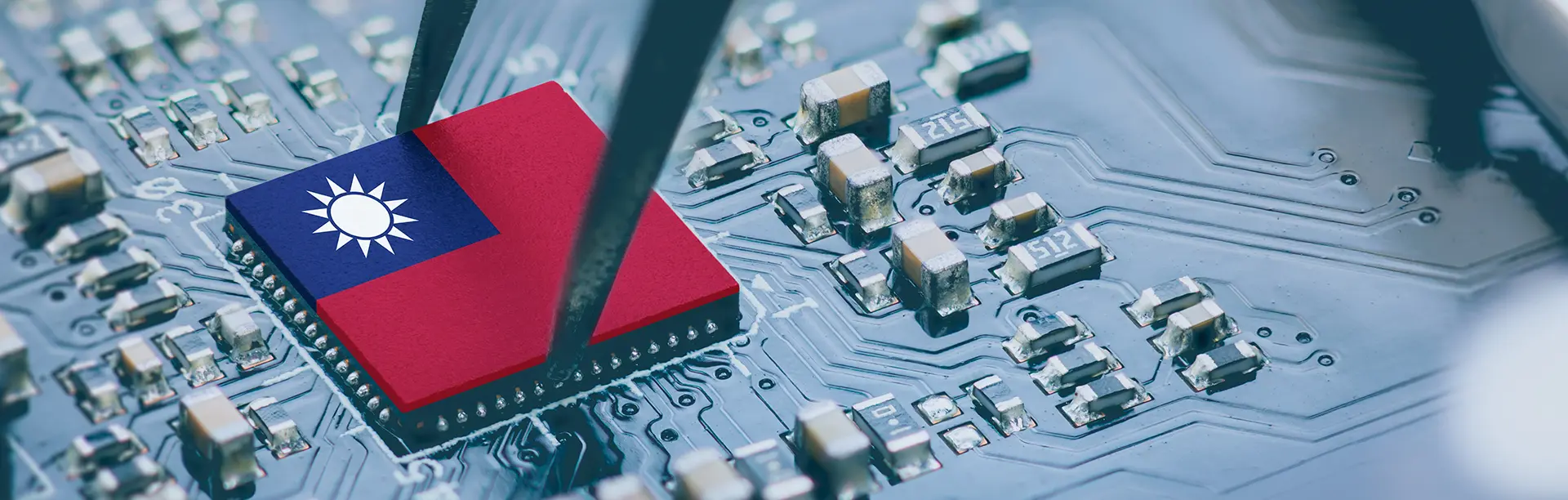
Taiwan’s unmatched supremacy of the chip sector is the backbone of its economic prosperity and the fulcrum of its geopolitical exposure. Taiwan’s chip exports - primarily high performance semiconductors applied to AI and advanced computing have catalyzed upward revisions in GDP forecasts and reinforced Taiwan’s indispensability in the global supply chain. However, along with this prosperity comes energy dependencies as well as geoeconomic risks that render the outlook anything but unalloyed.
Advanced packaging, in the form of TSMC’s CoWoS (chip on wafer on substrate) technology, has emerged as the pivot of the AI era, transforming from a technical process to a strategic bottleneck. Moreover, Taiwan’s central bank on September 18, 2025 revised its growth forecast for 2025 to 4.55% up from June’s 3.05%, attributing the increase largely to semiconductor exports. Electronics and ICT products constituted 42.2% of Taiwan’s total exports in the first 8 months of the year, valued at nearly USD$400 billion,which demonstrates the dominance of this industry.
However, the Bank also predicted a change to 2.86% in 2026, cautioning against tariff headwinds, as well as heightened policy uncertainty. Additionally, Taipei has been active in leveraging its semiconductor prowess into geopolitical leverage. At SEMICON Taiwan 2025, government officials spoke openly about semiconductors as instruments of “chip diplomacy”, which suggests Taiwan’s interest in binding its democratic allies more closely through technology than formal diplomatic recognition Institutional alignment has followed. The appointment of Kung Ming-hsin (former TSMC board member, as Minister of Economic Affairs) further institutionalizes the connection between national policy and industrial strategy
Furthermore, the AI supply chain’s weakest point is not wafer lithography but advanced packaging capacity. Demand for CoWoS outstrips available throughput, compelling TSMC to double its capacity by adding new sites in Chiayi and elsewhere. Additionally, CoWoS (once a relatively obscure process), has become a geopolitical tool: without it, Nvidia’s GPUs cannot properly match compute dies with high bandwidth memory, the dividing line between cutting edge AI and obsolescence.
The chip giant is bumping up against infrastructural limits. TSMC alone consumed 6.4% of Taiwan’s power in 2021; by 2025 fab expansions and AI targeted data centers have raised that figure significantly. For example, Foxconn- Nvidia AI factory in Koshiung, which was originally planned at 100MW will be developed in phases “subject to power availability”- a sidelong acknowledgement of Taiwan’s strained grid. Industry groups have demanded a moratorium on further electricity price hikes, arguing that higher tariffs would erode competitiveness and burden households.
Complicating matters, Taiwan shut down its last nuclear reactor in May 2025, increasing reliance on imported liquefied natural gas while also pledging net zero. This double blind energy security has become an existential policy dilemma. Externally, Taiwan faces a matrix of threats. US tariff measures against specific Taiwanese products cast a pall over 2026, even as semiconductors receive exemptions in some categories. Meanwhile, Nvidia’s US$5billion investment in Intel hints at a potential restructuring of the global AI compute stack. If successful, it could dilute Taiwan’s stranglehold on advanced packaging, though for now at least, leading edge manufacturing remains Taiwan-centric. However, in comparison, Huawei’s resurgence in indigenous chip design presents a long term competitive counterweight which intensifies the regional tech race.
All in all, Taiwan’s semiconductor sector is simultaneously its greatest strength as well as being its most vulnerable weakness. Its economic windfall has propelled GDP growth to heights beyond expectations but its infrastructural vulnerability especially in packaging and energy threatens to truncate the very gains it generates. Therefore, over the next 2 years, Taiwan needs to insert CoWoS capacity, steady its energy supply, and balance geoeconomic risk without sacrificing comparative advantage. Success would solidify Taiwan’s status as the fulcrum of the AI era; failure to do so could expose its prosperity as perilously contingent.
By: Megan C
Sources:
Reuters – Taiwan c.bank leaves benchmark rate unchanged at 2%
https://www.reuters.com/markets/asia/taiwan-cbank-leaves-benchmark-interest-rate-unchanged-2-2025-09-18
Reuters – Taiwan central bank raises growth forecast, warns of tariff risks
https://www.reuters.com/markets/asia/taiwan-central-bank-raises-growth-forecast-warns-tariff-risks-2025-09-18
FocusTaiwan (CNA) – Taiwan’s exports January–August 2025, electronics 42.2%
https://focustaiwan.tw/business/202509200015