VWAP (Volume Weighted Average Price)
The average price everyone has paid today, weighted by how many shares traded at each price. Why day traders and big funds treat it as the line in the sand.
What is VWAP?
VWAP stands for Volume Weighted Average Price. It is the average price of a stock today, but trades with more shares count for more.
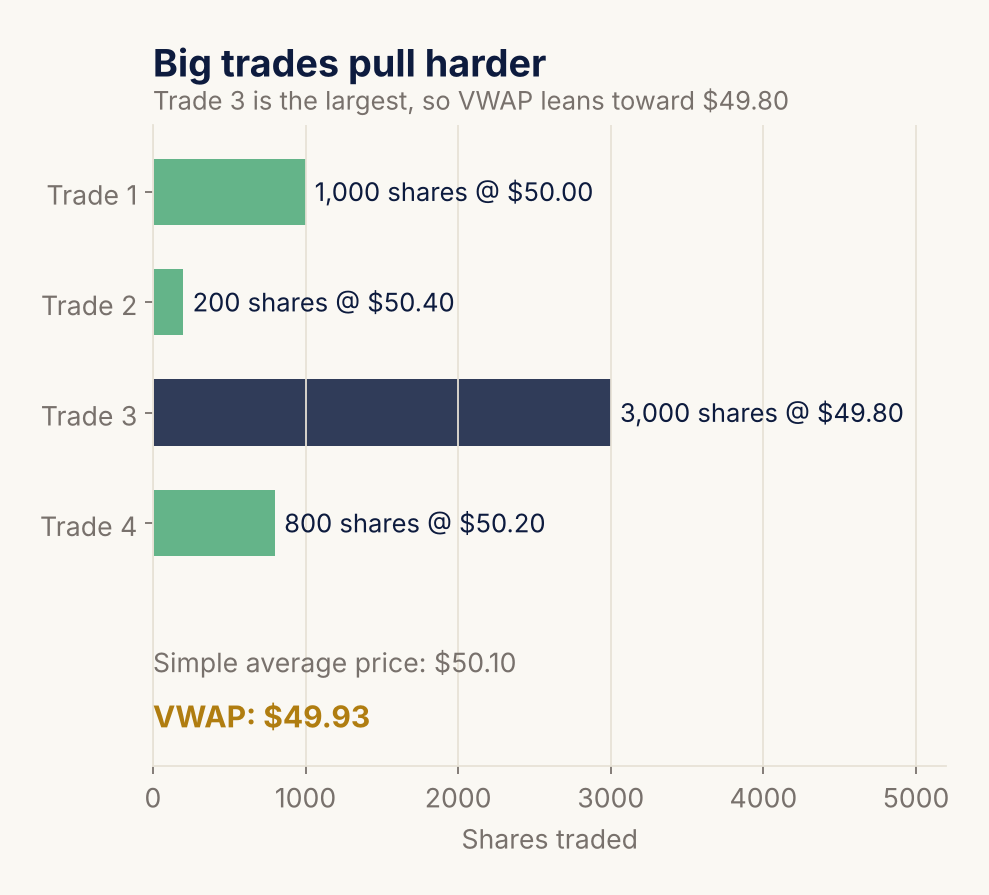
Say four trades happen: 1,000 shares at $50.00, 200 at $50.40, 3,000 at $49.80, and 800 at $50.20. A simple average of the four prices is $50.10. But most of the shares changed hands at $49.80, so the VWAP is $49.93.
The formula: VWAP = total of (price × shares) ÷ total shares. On a chart, each candle uses its typical price, (high + low + close) ÷ 3.
VWAP resets every day
Unlike a moving average, VWAP starts over at the opening bell each morning and builds up through the session. That makes it an intraday tool, used on 1-minute, 5-minute, or 15-minute charts. On a daily chart it is not very useful.
How traders use it
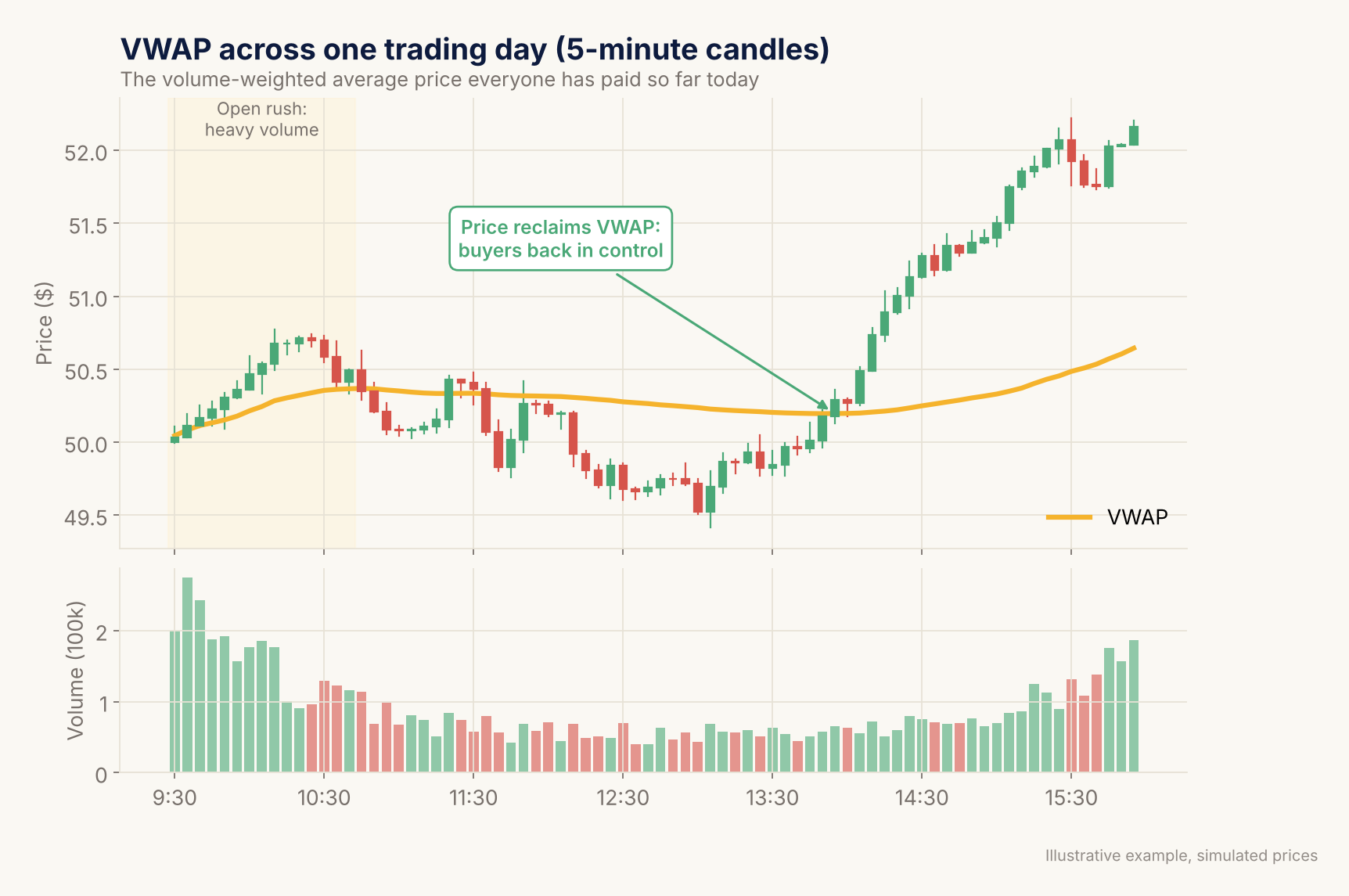
Above VWAP: the average buyer today is in profit, and buyers are in control.
Below VWAP: the average buyer today is losing money, and sellers are in control.
Reclaiming VWAP: when price falls below and then climbs back above it, like the afternoon on the chart, traders read it as buyers taking control again.
Large funds use VWAP as a report card. If a fund buys a million shares, buying below the day's VWAP means it got a better price than the average trader. Because big players watch it, VWAP often acts as support or resistance during the day.
Limits
Early in the morning VWAP has very little data, so it jumps around. Late in the day so much volume has piled up that the line barely moves.
It is also a lagging average, like every other average. Long-term investors holding for months rarely care about it. VWAP is mainly a tool for judging entries and exits within a single day.